
Turn your back on the sea for a day. It sounds like heresy on a Greek island, but Paros keeps some of its deepest charms in the hills: a string of inland villages where marble lanes wind between amphitheatres of olive groves, church bells mark the hours, and life continues much as it has for centuries. This is the Paros that existed long before tourism, and it is gloriously intact.
Here is a route through the island’s quiet heart, best savoured over a leisurely half day with a long village lunch at its centre.
Lefkes: The Marble Capital of the Hills
Begin with the jewel. Lefkes, folded into the mountains at the island’s centre, was the capital of Paros in medieval times, built high and hidden to escape the pirate raids that plagued the coast. Today it is widely considered one of the most beautiful villages in the Cyclades, and unusually, one of the least spoiled.
The village spills down its hillside in tiers of whitewashed houses, neoclassical mansions and flowered courtyards, all stitched together by lanes paved in the local marble. Cars cannot enter, which preserves both the silence and the magic. Wander without a plan: past tiny chapels, under archways, through squares shaded by plane trees where elderly gentlemen debate over coffee.
At the village’s heart rises the church of Agia Triada, an imposing 19th century basilica built almost entirely of Parian marble, its twin bell towers visible for miles. The view from its terrace, across rooftops and terraced hills all the way to Naxos, explains every photograph you have ever seen of Lefkes.
Before leaving, find a kafeneio in the upper village for a Greek coffee or a fresh orange juice. The pace of Lefkes is contagious, and that is precisely the point.
The Byzantine Path: Walking on a Thousand Years
From the lower edge of Lefkes begins one of the loveliest short walks in the Aegean: the Byzantine Path, a medieval trail paved in marble slabs, worn smooth by a millennium of feet, hooves and cartwheels. It descends gently for about 3.5 kilometres through olive groves, dry stone walls and open hillside to the village of Prodromos, with the sea glittering ahead in the distance.
The walk takes about an hour at a stroll, is manageable for most ages, and is best in the morning or late afternoon light. Wear proper shoes, carry water, and pause often; the silence, broken only by goat bells and cicadas, is the soundtrack of old Paros.
Prodromos: The Whitewashed Maze
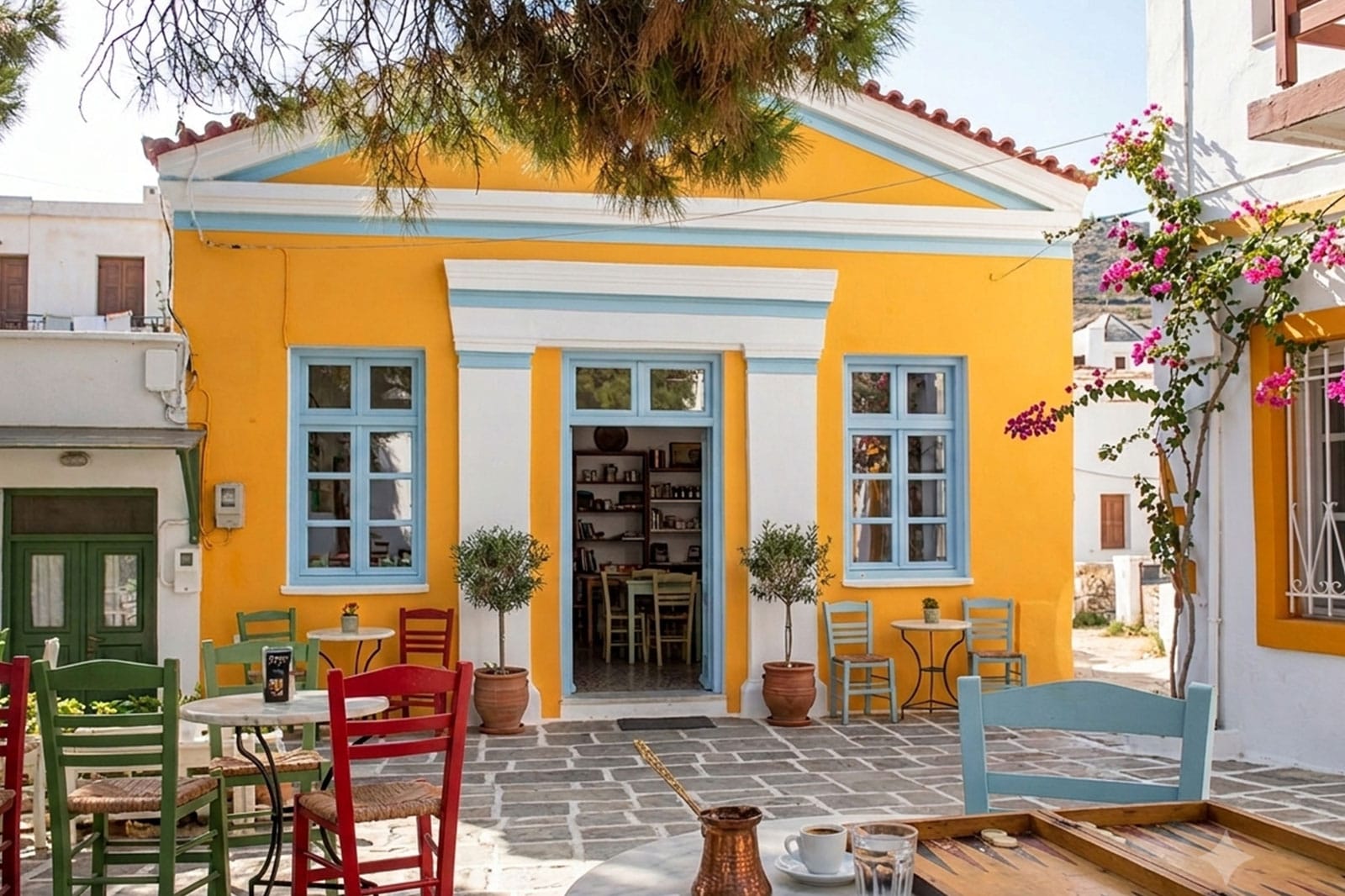
At the path’s end waits Prodromos, a small farming village that concentrates everything charming about Cycladic architecture into a few perfect lanes. You enter through an archway beneath a chapel, into a maze deliberately designed to confuse raiders, and today happily confusing visitors into slowing down. Whitewash is renewed constantly, geraniums blaze against the white, and the village square, with its taverna tables under the trees, may tempt you to abandon the rest of the itinerary entirely.
Marpissa: Sculpted Stillness
A few minutes on, Marpissa rises on its low hill, larger than Prodromos but equally serene. Its lanes reward slow exploration: restored windmills, sculpted marble doorframes, hidden courtyards and small folk museums that open in summer. Above the village looms the hill of Kefalos, crowned by the monastery of Agios Antonios and the scattered ruins of a Venetian fortress; the short drive or determined walk up is repaid with one of the widest views on the island, across the strait to Naxos.
Kostos: The Unhurried Original
Completing the circle back towards Parikia, tiny Kostos sees the fewest visitors of all, which is its quiet distinction. A couple of tavernas around a sleepy square, a handsome church, and the sense of a village living entirely for itself. Birthplace, incidentally, of Athanasios Parios, one of the great Greek scholars of the 18th century. Stop for a coffee and feel the clock lose its authority.
The Long Village Lunch
The inland villages hold some of the most authentic tavernas on Paros, places where the menu follows the garden and the grandmother, not the tourist. Slow cooked goat, rabbit stifado, handmade cheese pies, horta from the hillside, and house wine by the carafe. Prices are gentler than the coast, portions are generous, and nobody has ever been rushed through a meal here. Plan your route so that lunch lands in Lefkes or Prodromos, and give it two hours minimum.
Practical Notes
- The route: Lefkes, Byzantine Path walk to Prodromos, then Marpissa and Kostos by car. From the south coast, Lefkes is roughly 25 minutes’ drive.
- Walkers’ logistics: with one car, park in Lefkes, walk the path, and taxi or walk back up. Energetic pairs can leave a second car in Prodromos.
- When: morning for the walk and light, or late afternoon for the golden hour on the marble. Villages observe the afternoon quiet, so time your wandering accordingly.
The Other Paros
Beaches fill the days on Paros, but the inland villages furnish the memories with texture: marble under your feet, mountains at your back, and a Greece that predates every brochure. Half a day is enough. You will wish you had given it more.
Villa Azzuro, above Faragas Beach on the south coast, puts Lefkes and the villages within an easy 25 minute drive, and welcomes you home to a swim afterwards. [Check Availability →]


Comments are closed