
Most visitors meet Parikia twice: once stepping off the ferry, and once catching it home. In between, they head straight for the beaches and villages, leaving the capital largely unexplored. It is an understandable mistake, and a real shame. Behind the busy waterfront lies one of the loveliest old towns in the Cyclades, layered with four thousand years of history, and at its best precisely when the day trippers are elsewhere.
Give Parikia an unhurried evening. Here is what it will give you in return.
Panagia Ekatontapiliani: The Church of a Hundred Doors
Begin with the monument that alone justifies the visit. Just behind the port, set in a peaceful walled courtyard, stands Panagia Ekatontapiliani, one of the oldest and most important churches in the Christian world, founded in the 4th century and associated with Saint Helen, mother of Constantine the Great.
The name means “she of the hundred doors”, and legend insists that only ninety nine have ever been found; the hundredth, they say, will reveal itself when Constantinople is Greek again. Inside, the atmosphere is extraordinary: ancient marble columns, a carved iconostasis, a baptistery from the early Byzantine era considered among the best preserved in the Eastern Mediterranean, and a stillness that feels centuries deep. The small Byzantine Museum in the grounds rewards a further twenty minutes.
Dress respectfully (shoulders and knees covered) and go either early or towards evening, when the courtyard is at its calmest.
The Old Town: Marble Lanes and the Frankish Castle
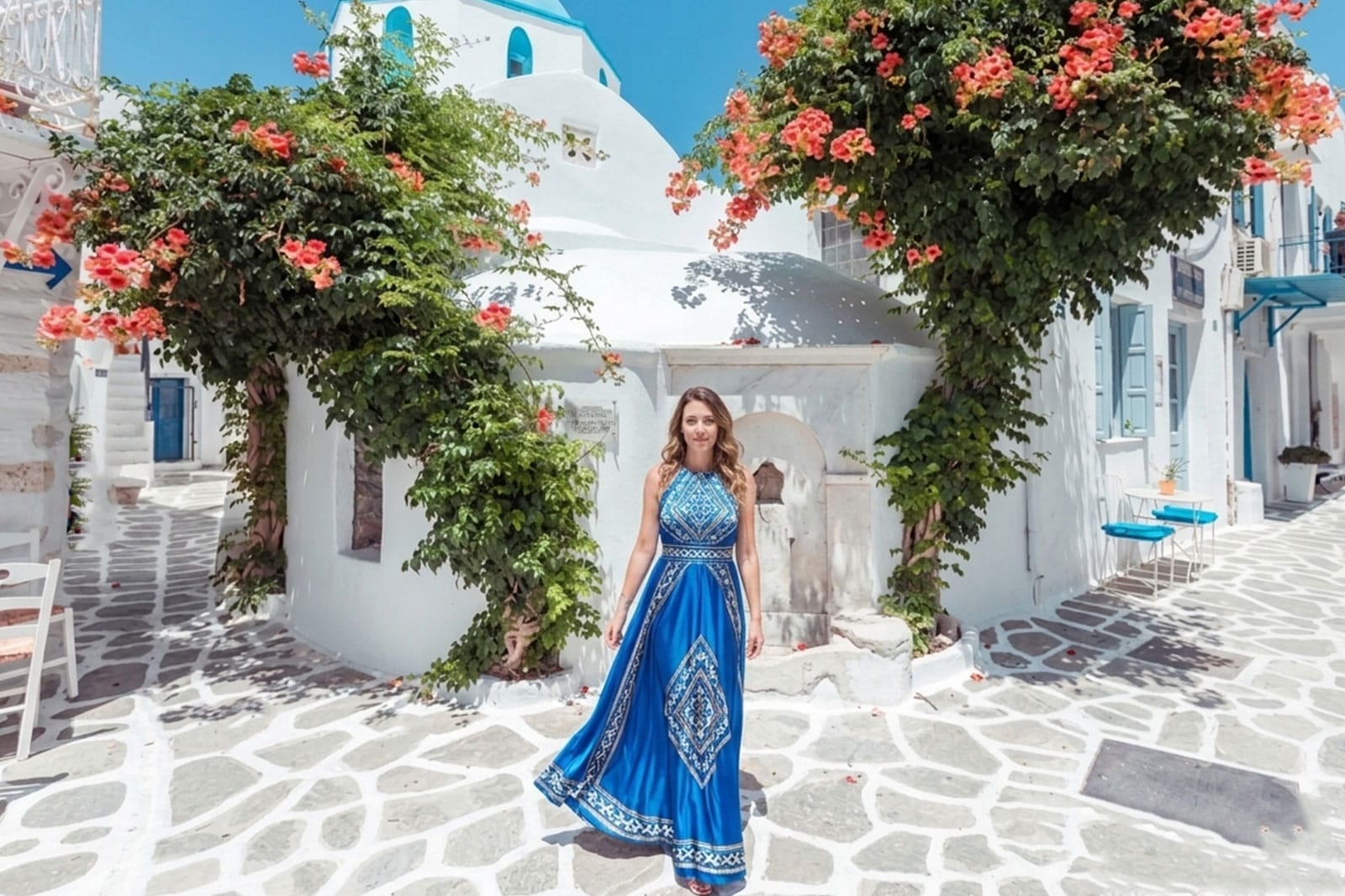
From the church, drift inland and let yourself get lost. The old town of Parikia is a classic Cycladic labyrinth, deliberately confusing to disorient medieval pirates, and today one of the most photogenic quarters in the Aegean: whitewashed houses, blue shutters, arches heavy with bougainvillea, and lanes paved in Parian marble polished by centuries of footsteps.
Climb gently uphill and you will find the Frankish Castle, built by the Venetians in the 13th century. Its walls are a marvel and a history lesson in one: the builders recycled the ruins of ancient temples, so column drums and marble blocks from a temple of Athena sit stacked in the walls like an architectural collage. Sunset from the castle terrace, looking over the rooftops to the bay, is one of the finest free spectacles on Paros.
Ancient Paros: The Archaeological Museum
Paros was famous throughout the ancient world for one thing above all: its marble. The translucent white stone from the island’s quarries became the Venus de Milo, the Hermes of Praxiteles and countless masterpieces of antiquity.
The Archaeological Museum of Paros, beside the school behind Ekatontapiliani, tells this story with quiet confidence. Its treasures include a monumental statue of the goddess Artemis, striking Cycladic figurines, and a section of the celebrated Parian Chronicle, an ancient marble timeline of Greek history. It is a small museum, easily enjoyed in under an hour, and rarely crowded.
The Waterfront at Golden Hour
As evening falls, return to the water. The southern end of the bay, along the road towards the windmill and beyond, becomes a promenade of cafes and bars facing directly west. This is where Parikia stages its daily masterpiece: the sun sinking into the Aegean behind the silhouettes of ferries and fishing boats, the sky cycling through amber, rose and violet.
Claim a table an hour before sunset, order something cold, and do nothing else. The little whitewashed chapel of Agios Konstantinos, perched above the castle quarter with its blue dome against the evening sky, is the classic photograph; the view from its terrace is even better in person.
Where to Eat
Parikia’s dining scene is broader than its port front suggests. A short walk into the back streets reveals family tavernas serving slow cooked classics, contemporary Greek kitchens, and ouzeries where locals linger over small plates. As a rule of thumb: one street back from the water, the food improves and the prices soften. In summer, book ahead for the better known spots or eat early, before 20:30, Greek families rarely dine before nine.
Practical Notes
- Getting there: about 20 minutes by car from the south coast, with parking most easily found along the ring road or near the windmill roundabout in the evening.
- Best time: late afternoon into evening. Shops reopen after the afternoon quiet, the light turns golden, and the town exhales.
- Combine with: ferry arrivals or departures, obviously, but the capital deserves its own dedicated evening at least once.
The Capital, Reconsidered
Parikia rewards the visitor who stays past the ferry queue: a church of legend, a castle built from temples, marble lanes, museum treasures and the best sunset promenade on the island. Twenty minutes from the peace of the south coast, it is the perfect evening excursion.
Villa Azzuro, above Faragas Beach, places you 20 scenic minutes from Parikia and a world away from its bustle. Explore by evening, return to silence by night.


Comments are closed